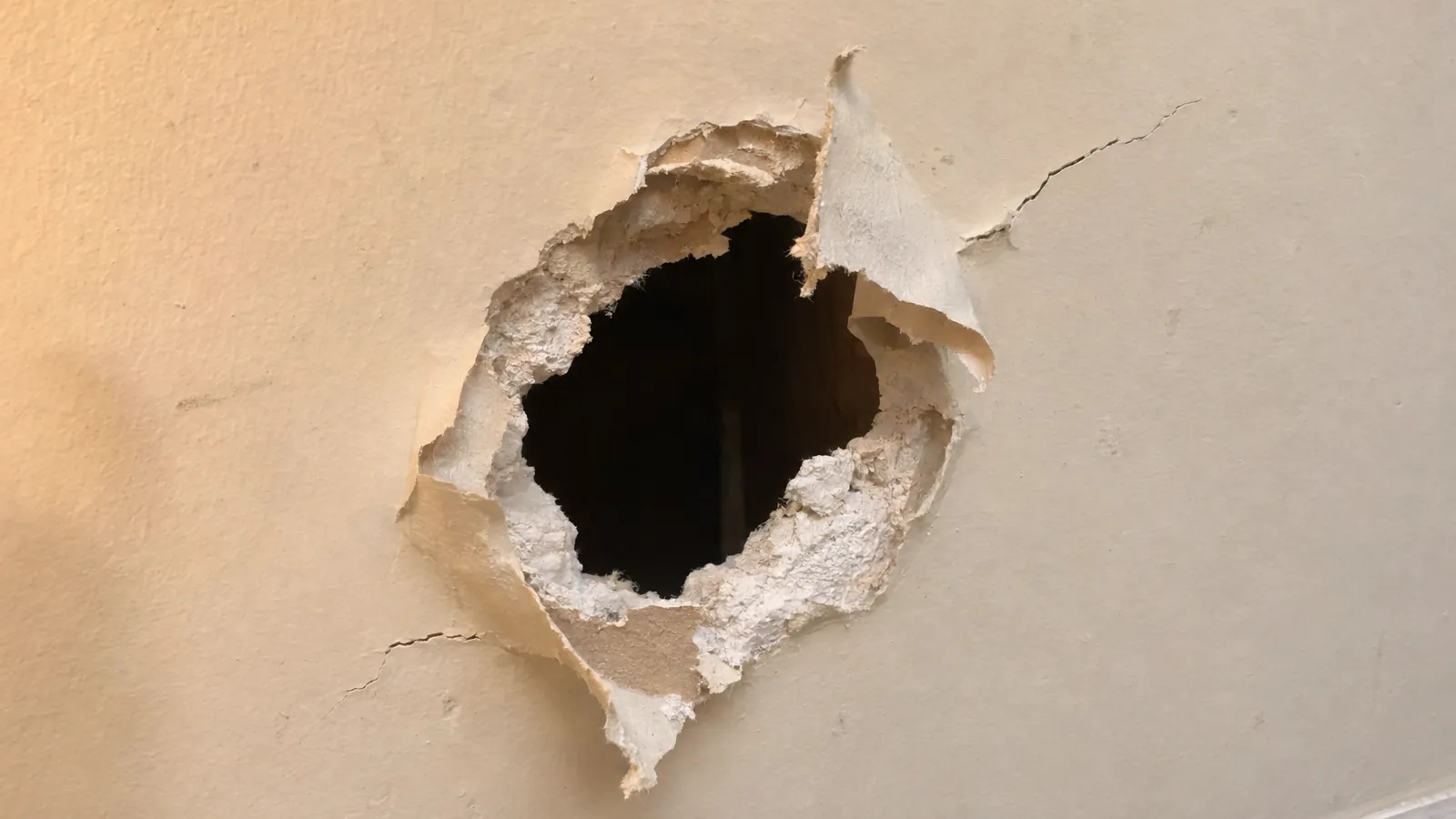
Drywall Repair in Montgomeryville, PA
Popped nails, split seams, ceiling rings from ice dams and leaky tubs, and holes of every size, repaired with the right compound and feathered into the surrounding wall until the repair is tough to spot after painting.
(445) 290-4678Check availability
One call gets a local drywall pro lined up to price the repair before anything is touched.
Call 7 days, 7am–9pm
Text the detailsand add a photo of the damage.
Montgomeryville weather, season by season, on your walls
Montgomery Township sits in a hot-summer humid continental climate, and drywall feels every swing of it. Wikipedia puts the average monthly temperature in Montgomeryville at 29.9 °F in January and 74.3 °F in July. That spread is what drives most seasonal wall and ceiling damage here: wood framing dries and shrinks through the heating season, then takes on moisture again in a muggy August.
Winter, ice at the eaves. The published normals for nearby Doylestown give a January average low of 21.3 °F against an average high of 38.6 °F, so snow on a roof can melt by day and refreeze at a cold overhang by night. That is how ice dams form, and when meltwater works its way beneath the shingles it tends to show first as a tan ring on an upper-story ceiling, just in from the eaves side of the room.
Late winter, cracks at the top floor. In a two-story house with a trussed roof, the bottom chords of the trusses sit in warm attic insulation while the top chords sit in cold air. The difference can lift the trusses a fraction of an inch, tugging the ceiling up off the tops of interior partitions and opening a straight crack where they meet. These cracks often close again in spring, which is why a flexible repair beats a quick skim of compound.
Summer, rain and humidity. The wettest month in the Doylestown normals is July, at just over five inches. Heavy summer storms test window flashing, sump pumps and basement walls, and finished lower levels with drywall run to the slab are the first place it shows.
Four repairs, done with the right mud for each
Each job below is priced up front by a drywall finisher who works locally. Each page explains how a sound repair is built, layer by layer, and what to ask about.
Several of these often turn up in the same house, and one quote can cover them all.
Nail Pop and Seam Crack Repair
Popped fasteners reset with drywall screws, and split joints re-taped with paper and feathered back flat.
Fixing pops and seam cracksCeiling Water Damage Repair
Ice-dam and bathroom-leak rings primed over with a stain-locking coat, soft board replaced and the texture redone.
Stained ceiling repairFinished Basement Water Damage
Board that wicked up water removed in a level strip once the room dries, then rebuilt with moisture-resistant panels.
Rebuilding basement wallsDrywall Hole Patching
Doorknob dents to fist-sized breaks, closed with mesh, a California patch or a backed insert and blended in.
Patching holes of any size
Answers about mud, paint and how long it all takes
Will I see the repair through new paint?
Not when the compound is spread wide and primed. Fresh compound absorbs paint unlike the old wall around it, so a proper repair is sealed with primer before the finish coat, and the paint is rolled out past the patch edge rather than dabbed on. With a wall paint that has aged, repainting the whole wall corner to corner hides a repair far better than touching up a square.
Can the texture on my wall or ceiling be copied?
Most texture can. Light orange peel goes on by sprayer or roller, knockdown is spattered on, left to firm up a minute, and troweled down, and a smooth wall is skimmed with a thin final coat. A photo of the area in raking light, sent by text, tells the pro a lot about what is on your wall before the quote.
Is a single nail pop or one small crack worth a call?
Yes. A small job is still a job, and several little repairs in one house are usually priced together as one job. Tell us everything on the list when you call so the quote covers it all.
How many days does a drywall repair need?
It depends on the compound. Setting-type mud hardens chemically in 20 to 90 minutes, so a small patch can be built and sanded in a day. Ready-mixed compound dries by air and needs each coat dry before the next, which can stretch a larger job across two or three days.
How much dust and mess should I expect?
Some, but it can be kept small. It's fair to ask the pro about sheeting off doorways, canvas on the floor and wet-sponge or vacuum sanding on the final coat. Pulling chairs and dressers a few feet out helps too.
Mesh, California patch or a new piece of board?
Three ways to close a hole, each suited to a different size and spot. Which one fits is settled in the quote; this table shows why one gets picked over another.
| Self-adhesive mesh patch | California (butterfly) patch | Cut-out with backing and new board | |
|---|---|---|---|
| Hole size it suits | Up to about fist size | From 2 up to about 6 inches | Bigger than a hand, or a soft, wet area |
| What holds it | Fiberglass mesh stuck over the hole | Its own paper flange, bedded in compound | Wood or metal backing screwed behind the old board |
| Compound used | Setting-type for the first coat, topping to finish | All-purpose to bed the paper, then topping | Paper tape on the seams, setting-type then topping |
| Coats before sanding | Two or three | Two or three | Three, feathered 12 inches or more past the seams |
| Where it suits | Flat wall, no stress | Flat wall, crisp edges needed | Ceilings, doorknob spots, anywhere it takes knocks |
Montgomeryville's houses, from the 1980s boom outward
The Census Bureau's latest five-year survey counts 4,997 homes in the Montgomeryville census-designated place. The single biggest group, 1,605 of today's homes, dates from the 1980s, and another 1,106 from the 1990s. Together that is more than half of everything standing. The township's population tells the same story: 5,718 people in 1980, 12,179 in 1990 and 22,025 by 2000.
In houses of that age the walls are gypsum board hung in sheets, taped at the joints and fastened to wood studs. Board from that era was often hung with nails rather than screws, and nails are what back out and lift a round blister of paint as framing lumber dries over the decades. Tapered seams across a ceiling, and corners finished with metal bead, are the other spots that wear first.
The mix leans heavily toward owners: 4,389 of the 4,843 occupied homes are owner-occupied. Attached homes make up a big share too, with 1,709 single-unit attached houses next to 2,830 detached ones. In a townhouse, a shared party wall and a stacked bathroom are common sources of ceiling stains on the floor below.
A smaller group is older: 91 were built in 1939 or before and 262 in the 1950s. Those can hold plaster on lath or early gypsum lath instead of modern board, and our walk-through on plaster, lath and early gypsum board covers how those repairs differ.
Five Points outward, to the boroughs and over into Bucks County
Montgomeryville comes first: the census-designated place around the Five Points crossing of PA 309, PA 463 and US 202 Business, and the rest of Montgomery Township with it. The same goes for the towns that sit around it.
- Lansdale and North Wales, the boroughs to the west and southwest, both on the Lansdale/Doylestown rail line.
- Colmar just to the north on Bethlehem Pike, and Hatfield beyond it to the northwest.
- Line Lexington and Chalfont to the north and northeast, over the line in Bucks County.
- Horsham, the township bordering Montgomery Township on the southeast.
Each one gets a line or two on the page covering every town served.
Garages and finished basements
The walls that take the most abuse in a house are often the ones below grade or behind the car. They fail differently from bedroom walls, so they are repaired differently too.
The garage wall shared with the house. In an attached garage, the wall and ceiling between the garage and the living space are there partly to slow a fire. They are often hung with the thicker five-eighths Type X panels, which has glass fibers in the gypsum core. A hole or a cut-out on that side should be patched with the same thickness of fire-resistant board and taped with all joints filled, not closed with a mesh square. Ask for it by name.
Impact damage. Bikes, car doors, trash bins and ladders dent garage board at bumper height. Because nobody needs a glass-smooth finish there, a sound repair can stop at a level-3 or level-4 finish, which keeps the cost down.
Finished basements. Drywall run tight to a concrete slab pulls water up into itself the way a paper towel does. After a sump failure or a heavy summer storm, the board can look dry at eye level while the bottom foot is soft and smells musty. The fix starts with drying the room fully, and a sound replacement leaves a half-inch space at the slab and uses panels made to shrug off damp and mold.
When to wait. If a foundation wall still sweats, or the slab is still damp under a rug, new board will only soak it up again. The cause gets solved first; the drywall goes back after. There is more on this on the basement water damage page.
Common cases around a tract-built house
These come up again and again in houses of this age. Each one comes with the steps a careful repair takes; the nail pop and crack page goes deeper on the last two.
A doorknob dent behind a bedroom door
The knob has crushed a round hole through the face paper. The broken gypsum is trimmed back, a backed patch or a California patch goes in, and a rubber stop on the baseboard spares the next patch.
A row of small round blisters across a ceiling
Those are nail pops lining up with a ceiling joist. Each nail is driven or pulled, a new drywall screw goes in beside it, clamping the board back to the joist, then each spot gets compound, sanding and primer.
A tan ring upstairs after a snowy February
Usually an ice dam. Once the roof is dealt with and the board tests dry, a coat of stain-blocking primer is rolled over the ring, and only soft or sagging board is cut out and replaced.
A straight crack where a hallway ceiling meets a wall
Often truss uplift. Rather than filling it with rigid compound that will crack again, a sound repair uses a flexible approach so the ceiling can shift with the seasons and the corner stays intact.
Send the details and the measurements
A few words on what happened, where it is and roughly how big it is goes a long way. A texted picture shot from a few steps back, lights on, helps a great deal.
Sending it okays texts and phone calls from the local pro pricing it and Montgomeryville Drywall Repair. Privacy
Next comes a call from a Montgomery Township drywall pro, who walks through the damage with you and prices it.
Montgomeryville walls, back to paint-ready
Holes, pops, stains and seams, the cost settled first by a local finisher, the work after.
Check availability by phoneText the details
Your first call starts the pricing; a Montgomery County drywall finisher settles the number ahead of any mudding.
How we work